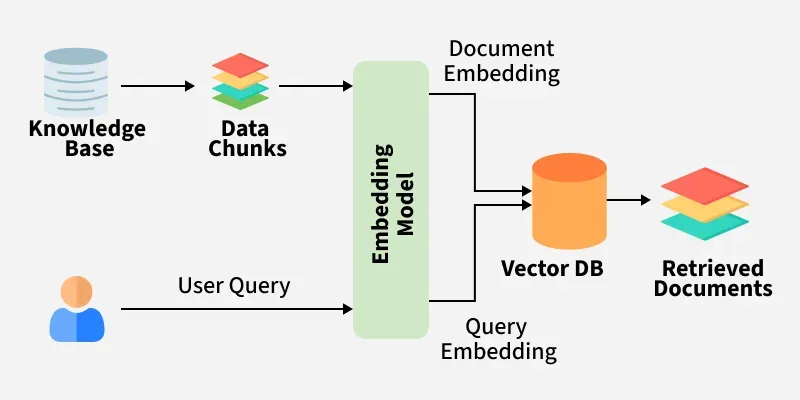
How Retrieval-Augmented Generation (RAG) Works ?
Hansraj Swami
Data Scientist & ML Engineer
3 min read
Retrieval-Augmented Generation (RAG) is not just a technique; it is a foundational element making artificial intelligence more reliable, useful, and enterprise-ready. A few years ago, the ability of Large Language Models (LLMs) to generate human-like text was considered groundbreaking. However, as businesses began deploying AI in production environments, a critical issue emerged: hallucinations. An AI system that confidently provides incorrect information is significantly more dangerous than one that admits it does not know the answer. RAG was developed to solve this fundamental problem.
RAGLLMAgenticAiNLP
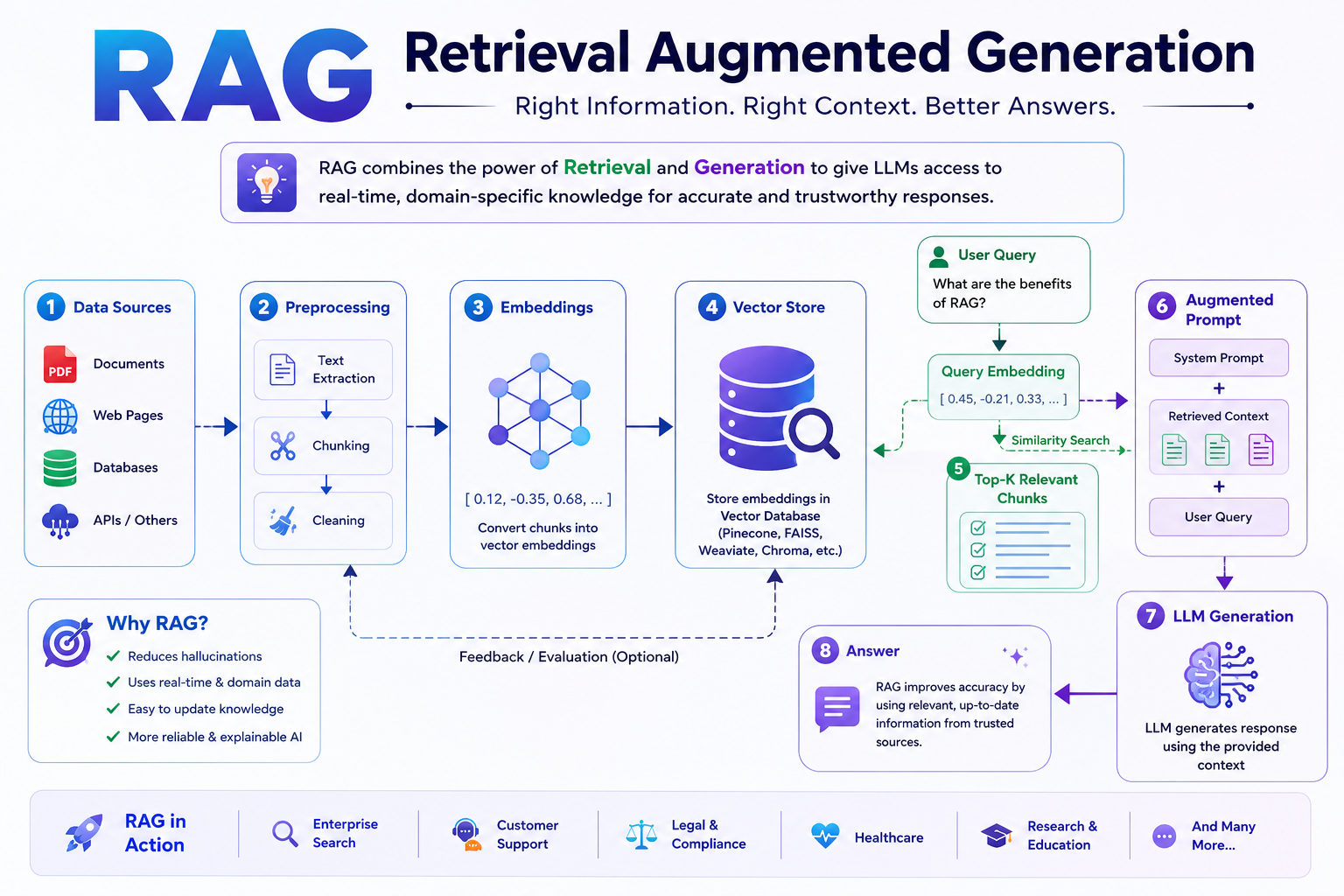 What is RAG?
Think of an LLM as a highly knowledgeable student who has read millions of books but lacks access to an organization's proprietary or up-to-date documents. RAG essentially provides this student with an open-book exam. Rather than relying solely on internal training data, the AI first retrieves relevant information from a trusted knowledge base and then generates a response based on that specific data. In simple terms: search first, process second, answer third. This workflow drastically increases the trustworthiness of AI outputs.
Why RAG is a Game Changer
Without RAG:
- AI relies exclusively on its pre-training data.
- It is prone to generating outdated information.
- It frequently hallucinates facts.
- It cannot access private, proprietary company data.
With RAG:
AI formulates answers using the most current enterprise documents.
Hallucinations are significantly reduced.
Responses become evidence-based and traceable.
Enterprise data remains valuable without the need for expensive model retraining.
Knowledge can be updated instantly by modifying the underlying database.
This is the primary reason almost every serious enterprise AI application today incorporates some form of RAG.
The Complete RAG Pipeline
(i)Raw Documents
(ii)Document Cleaning
(iii)Chunking
(iv)Embedding Generation
(v)Vector Database Storage (e.g., Pinecone, FAISS, Milvus, Chroma, pgvector)
(vi)User Query Input
(vii)Query Embedding
(viii)Similarity Search
(ix)Top-K Relevant Chunks Extraction
(x)Prompt Construction
(xi)Large Language Model Processing
(xii)Grounded Response Generation
(xiii)Every stage in this pipeline is critical. A weak chunking strategy or low-quality (xiv)embeddings will directly degrade the quality of the final output.
Industry Applications:
(i)Enterprise Knowledge Bases
(ii)Customer Support Chatbots
(iii)Legal Document Search and Analysis
(iv)Healthcare Assistants
(v)Banking and Financial Services
(vi)Research Assistants
(vii)E-commerce Product Search
(viii)Internal Company Copilots
(ix)Business Value
Organizations favor RAG because it eliminates the need to retrain entire models whenever new information becomes available. By simply uploading the latest documents to the knowledge base, the AI immediately leverages the updated context. This approach is simple, fast, and highly cost-effective.
Best Practices for Building a RAG System
- Clean and preprocess documents thoroughly before indexing.
- Select the optimal chunk size (too small loses context; too large degrades retrieval -accuracy).
- Utilize high-quality embedding models.
- Store embeddings in a scalable vector database.
- Retrieve only the most highly relevant chunks.
- Implement a re-ranking step before passing context to the LLM.
-Use metadata filtering for improved precision.
- Continuously evaluate retrieval quality, not just the LLM's final output.
- A fundamental rule of RAG is that even the most advanced LLM cannot generate a correct answer if the retrieved context is flawed.
Limitations of RAG
While powerful, RAG is not a flawless solution.
- Poor document quality inevitably leads to poor answers.
- Incorrect chunking can sever important context.
- Retrieval mechanisms may miss critical, relevant information.
- Standard vector search is sometimes insufficient for complex reasoning tasks.
- Large knowledge bases can introduce retrieval latency.
- The multi-component architecture increases engineering complexity.
- Continuous monitoring and evaluation are mandatory.
- The principle of "garbage in, garbage out" applies strictly to RAG systems.
The Future: Beyond Traditional RAG
Modern AI systems are evolving past basic RAG toward more sophisticated architectures:
- (i)Agentic RAG
(iii)Multi-Modal RAG
(iv)Hybrid Search (Keyword + Semantic)
(v)Multi-Agent RAG
(vi)Self-Reflective RAG
(vii)Corrective RAG (CRAG)
(viii)Adaptive RAG
These advanced methodologies are designed to make AI more accurate, explainable, and capable of solving complex, real-world problems.
Conclusion:
LLMs provided the ability to generate text. RAG provided the ability to generate text grounded in specific, verifiable knowledge. This distinction separates an AI that merely sounds intelligent from an AI that genuinely helps people make better decisions. The future of this technology relies not solely on building bigger models, but on achieving smarter retrieval, better context integration, and trustworthy generation.
Back to All Posts
Thanks for reading! Feel free to reach out on LinkedIn