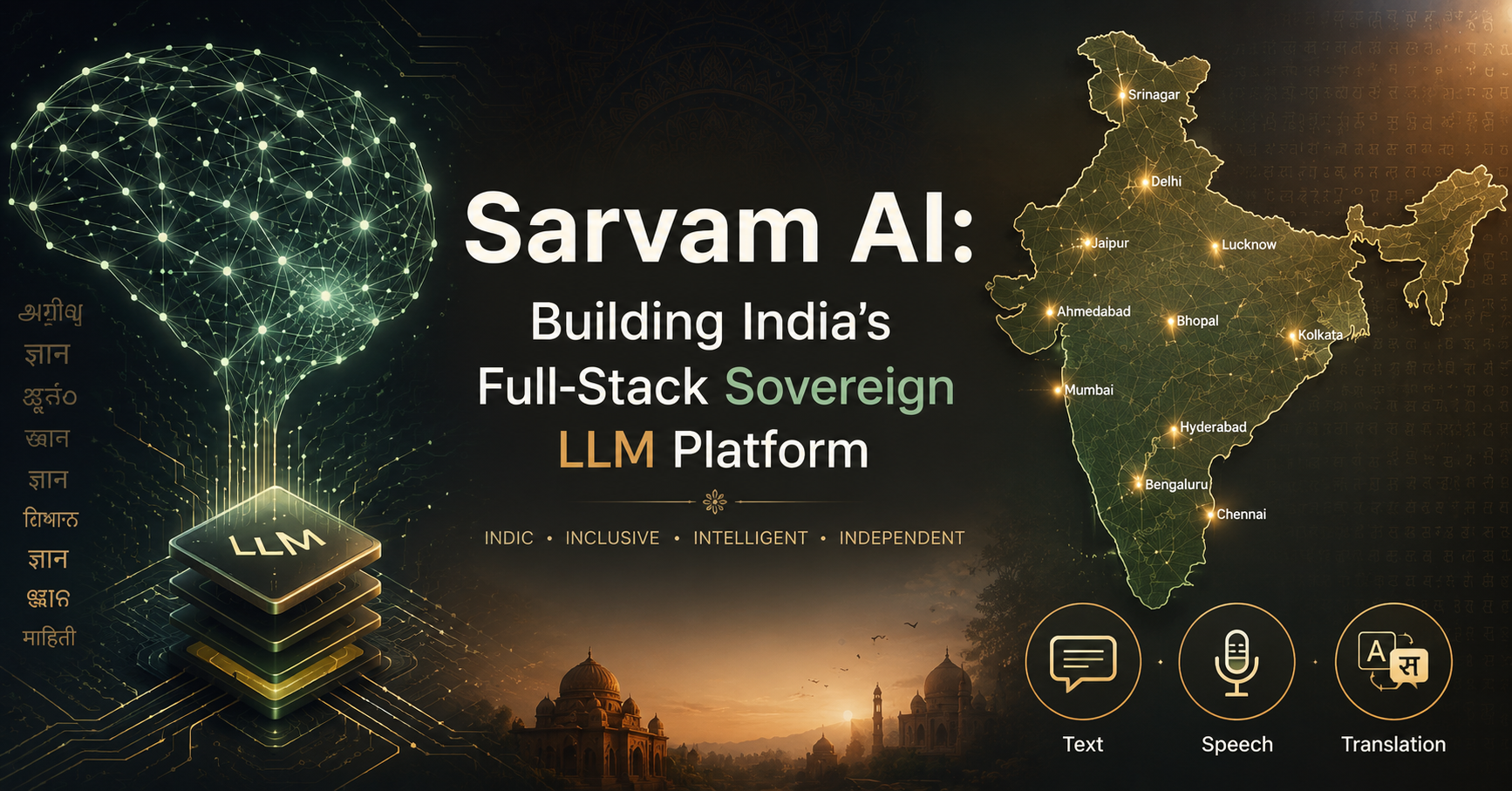
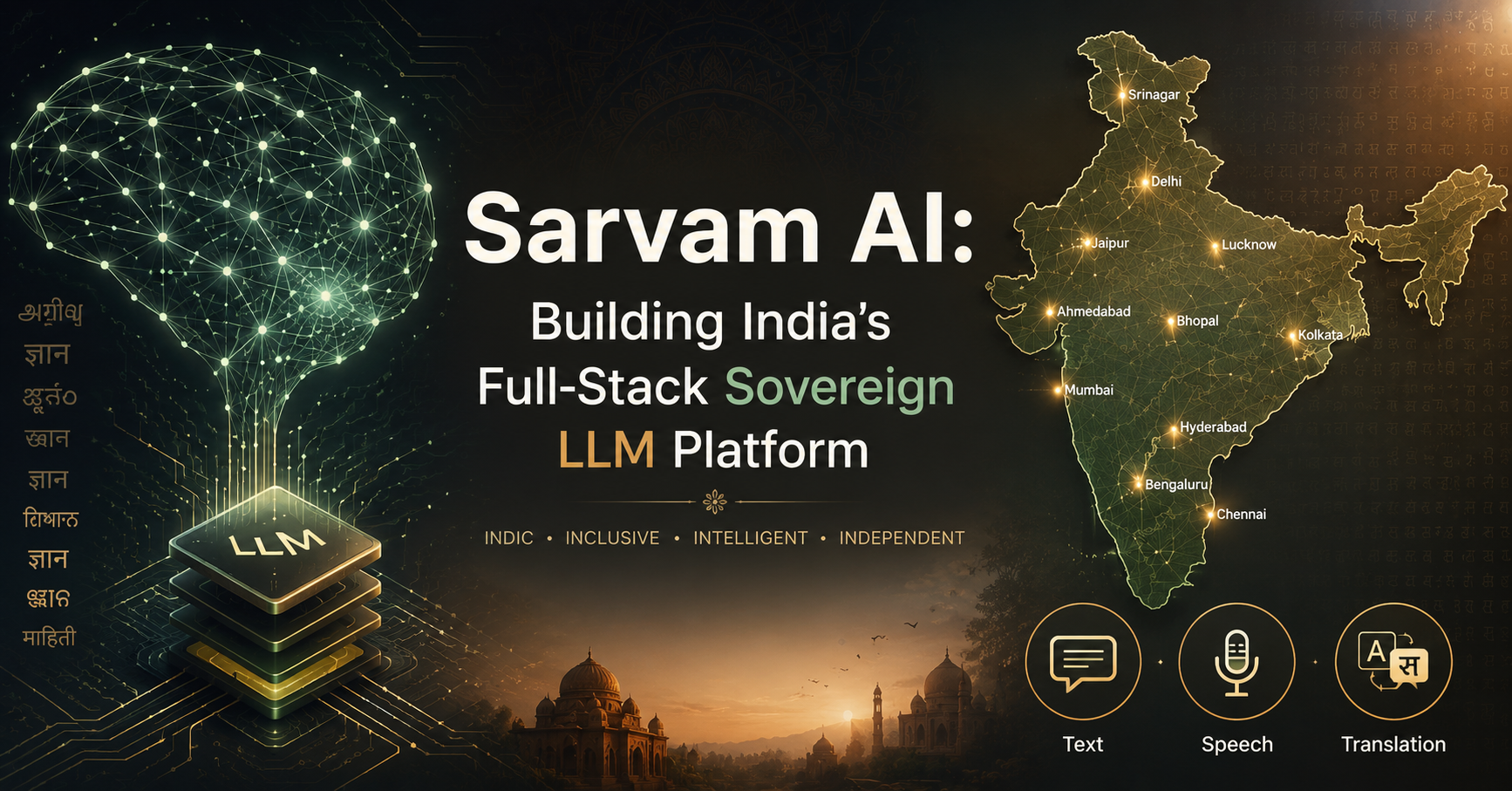
Sarvam AI: Building India’s Full-Stack Sovereign LLM Platform
Hansraj Swami
Data Scientist & ML Engineer
6 min read
India is in the middle of a foundational AI moment, and Sarvam AI sits at the core of that shift as a full-stack sovereign AI platform purpose-built for Indian languages and use cases. As a data science engineer, I’ve been closely following how Sarvam is designing, training, and deploying large language models (LLMs) that are optimized not just for English, but for India’s rich linguistic diversity, code-mixed text, and real-world enterprise scenarios.
LLMSarvam-30BSarvam-105B
From Indus to Sarvam-105B and Sarvam-M
Sarvam AI maintains a family of foundation and specialized models spanning text and speech, with a strong focus on Indic languages.
Indus – Early Indian-language LLM focused on region-specific use cases and multilingual support.
Sarvam-30B – A 30B-parameter reasoning model using a Mixture-of-Experts-inspired design, optimized for instruction following and multilingual text generation.
Sarvam-105B – Flagship Mixture-of-Experts (MoE) reasoning model:
105B total parameters, ~10.3B active per token for efficient inference.
Trained from scratch with Multi-head Latent Attention (MLA) for long-context reasoning, exposed via Sarvam’s APIs.
Sarvam-M (24B) – A hybrid, open-weights LLM built on top of Mistral Small, post-trained for robust math, programming, and Indian-language understanding.
Designed for conversational AI, machine translation, and education-focused tools, available via API and Hugging Face.
On top of LLMs, Sarvam also ships production-grade speech and translation models – speech-to-text, speech translation, text translation, and high-quality text-to-speech – all tuned for Indian accents and usage patterns.
Training Data: Sovereign, Multilingual, and Code-Mixed
A critical differentiator for Sarvam is the nature of its training data and the emphasis on Indian linguistic realities.
Multilingual Indian corpus:
Data spanning 22+ Indian languages and English, capturing formal text, colloquial content, and region-specific usage.
Code-mixed text:
Large volumes of Hindi–English, Tamil–English, and other code-mixed content, reflecting how Indians actually write and speak online.
Domain diversity:
Curated datasets covering programming languages, mathematical reasoning, scientific literature, and high-quality instructional data.
Sovereign data pipelines:
Data curation and training orchestrated in India, with Sarvam emphasizing that its LLMs are trained from scratch on Indian-language corpora using fully Indian data pipelines and infrastructure.
For Sarvam-M, the composition is slightly different: roughly 30% of the post-training corpus is Indic-language data, with the remainder balancing English and other language material to maintain strong global reasoning, coding, and mathematics performance.
Training Stack: From Scratch Training to SFT + RLVR
From an engineering perspective, Sarvam is interesting because it uses two distinct training paradigms depending on the model family.
1. Training from Scratch on Indian Data
Models like Sarvam-30B and Sarvam-105B are trained from scratch rather than just fine-tuned from existing global LLMs.
Key aspects:
Compute infrastructure:
Training runs executed on large GPU clusters (e.g., up to 1,024 H100 GPUs) using NVIDIA’s NeMo framework, with stable training runs (no catastrophic loss spikes), which is non-trivial at this scale.
Architecture:
Transformer-based backbone with Mixture-of-Experts (MoE) for the 105B model, keeping ~10.3B parameters active per token while using a much larger parameter pool for capacity.
Multi-head Latent Attention (MLA) enables long-context capabilities and efficient inference for enterprise-grade reasoning tasks.
Objective and curriculum:
Pretraining objectives centered on next-token prediction across multilingual, code-mixed, and domain-specific corpora, followed by instruction tuning for better alignment on Indian use cases.
2. Post-Training on Mistral Small: Sarvam-M
Sarvam-M follows a different path: it is built on top of Mistral Small using a multi-stage post-training pipeline.
Three major steps:
Supervised Fine-Tuning (SFT):
Sarvam trains the model on curated instruction-following datasets, programming problems, math reasoning tasks, and Indian-language dialogues to align behavior for both “think” (deliberate reasoning) and “non-think” (casual communication) modes.
Reinforcement Learning with Verifiable Rewards (RLVR):
A reinforcement learning stage where verifiable metrics (e.g., correctness of math answers, code execution results, syntactic validity, and task completion) are used to shape the reward signal.
This step significantly boosts performance on Indian-language GSM-8K-style math benchmarks, with reported improvements as high as +86% on romanised Indian language math tasks.
Inference optimizations:
Targeted optimizations for latency and throughput on NVIDIA GPU-accelerated systems, tuned for deployment via Sarvam’s API and platforms like NVIDIA NIM.
Together, these approaches allow Sarvam to offer both from-scratch sovereign LLMs and post-trained hybrid models, covering different performance, latency, and deployment constraints.
Model Serving: APIs, Long Context, and Indian-Language Applications
Sarvam exposes its models through a developer-friendly API stack, enabling teams to rapidly prototype and deploy Indian-language AI applications.
Core capabilities:
Chat completion:
Full conversational LLM interfaces powered by models like Sarvam-105B and Sarvam-M, used for chat agents, customer support automation, and internal copilots.
Text translation & transliteration:
High-quality translation between Indian languages and English, plus script conversion (e.g., Devanagari to Latin), simplifying cross-lingual content pipelines.
Speech-to-text and speech translation:
ASR models optimized for Indian accents and noisy environments, with direct speech-to-text and speech-to-text-translation APIs.
Text-to-speech:
Natural-sounding Indian voices for IVR systems, educational content, accessibility tools, and multilingual audio experiences.
Many models provide long-context windows (e.g., 32k–128k tokens for text LLMs), enabling practical use cases like legal document analysis, policy summarization, and large multi-document reasoning pipelines in Indian languages.
From an engineering standpoint, this looks like a layered architecture:
Model layer – Sarvam-30B, Sarvam-105B, Sarvam-M, plus speech/translation models.
Serving layer – API endpoints for chat, translation, STT, TTS, transliteration, and language ID.
Application layer – reference solutions for customer support, conversational bots, educational platforms, and localization workflows in Indian languages.
Benchmarks and Performance: Indic-Focused but Globally Competitive
On benchmarks, Sarvam’s models are tuned to shine on Indian-language and reasoning-heavy tasks.
Sarvam-M benchmarks:
Strong performance on math and programming tasks, often comparable to or exceeding models like Llama-3.3 70B and Gemma 3 27B in targeted benchmarks.
Significant gains (+86%) on combined Indian-language math benchmarks (e.g., romanised GSM-8K variants).
Slight trade-off (~1% drop) on some English-heavy knowledge benchmarks such as MMLU, reflecting a conscious rebalancing toward Indic tasks.
Sarvam-105B and Sarvam-30B:
Positioned as open-source reasoning models optimized for Indic languages, with open weights available via platforms like Hugging Face, enabling experimentation and fine-tuning by the broader community.
For a data science engineer building Indian use cases, this means we can finally choose models that natively understand Indian languages and code-mixed inputs, instead of forcing English-only or Western-focused LLMs into contexts they were not trained for.
Why Sarvam Matters for Indian Data Scientists and AI Engineers
From the perspective of an AI engineer working on Indian problems – whether deepfake detection, air quality modelling, or multilingual decision-support systems – Sarvam AI represents a critical evolution in the ecosystem.
We get from-scratch, India-trained LLMs with sovereign data and infrastructure, which is essential for sectors like governance, health, and finance.
We gain APIs tuned for Indian languages and speech, which dramatically reduces the friction in building conversational agents, analytics tools, and educational platforms localized to Indian audiences.
We can leverage hybrid models like Sarvam-M for high-stakes reasoning tasks (math, programming, policy analysis) while still respecting linguistic diversity.
As India moves ahead with the IndiaAI Mission and the concept of a sovereign LLM, platforms like Sarvam AI will likely form the backbone of many real-world deployments – from citizen-facing chatbots to environmental intelligence systems that communicate in local languages.
For data scientists and ML engineers, Sarvam offers both a research playground (open-source models, Hugging Face weights, long-context reasoning) and a production stack (APIs, NVIDIA-optimized serving) that can be directly integrated into Indian AI products.
Back to All Posts
Thanks for reading! Feel free to reach out on LinkedIn